The regulatory landscape around surface water drainage has shifted significantly, and if you’re working on residential or commercial developments in the UK, the requirements that apply to your projects have changed in ways that matter.
Sustainable Drainage Systems, universally referred to as SuDS, are no longer a design preference or a planning nicety. They are a legal requirement for most new developments in England and Wales, and the standards against which they are assessed have become more specific, more enforceable and more consequential for contractors who get them wrong.
This guide covers what SuDS are, what the current compliance requirements look like, what’s changed recently, and what contractors need to do to stay ahead of them.
Sustainable Drainage Systems are drainage solutions that manage surface water runoff in a way that mimics natural processes. Rather than collecting rainwater and discharging it as quickly as possible into a pipe, SuDS slow water down, store it temporarily, allow it to infiltrate into the ground where conditions allow, and treat it by removing pollutants before it reaches watercourses.
The term covers a wide range of techniques and structures. Rain gardens, swales, permeable paving, detention basins, green roofs, stormwater planters, filter strips and attenuation tanks are all SuDS components. Most schemes use several of these in combination, forming what’s known as a SuDS management train: a sequence of measures that progressively slow, store, treat and discharge surface water.
The underlying principle is that development should not increase the rate or volume of surface water runoff compared with the pre-development situation, and ideally should improve on it.
The UK has a surface water problem. Urbanisation has replaced permeable ground with hard surfaces at a scale and pace that drainage infrastructure was never designed to accommodate. Combined sewer systems in many towns and cities are overwhelmed by moderate rainfall events, triggering combined sewer overflows that discharge untreated sewage into rivers and coastal waters.
The consequences are well documented. Surface water flooding affects an estimated 3.2 million properties in England alone. River water quality has declined significantly in areas with high rates of combined sewer overflow activity. The Environment Agency has made reducing sewer overflows and improving river water quality a central regulatory priority.
At the same time, climate projections for the UK consistently point toward more intense, shorter-duration rainfall events alongside longer dry periods. The drainage challenge is getting harder, not easier, and the infrastructure deficit is not going to be closed by conventional pipe-and-gully solutions.
SuDS are a central part of the policy response to this problem, and the legislative framework around them reflects that.
Schedule 3 of the Flood and Water Management Act 2010 was finally commenced in England in April 2024, bringing England into alignment with Wales, where Schedule 3 had been in force since January 2019.
This is the most significant regulatory change for drainage contractors working in England in recent years. Under Schedule 3, SuDS are now a statutory requirement for new developments and redevelopments requiring planning permission in England. Specifically:
The commencement of Schedule 3 means that drainage approvals which previously sat with water companies or were handled informally through planning conditions are now subject to a formal statutory process with defined standards.
Wales has had Schedule 3 in force longer than England, and the Welsh experience provides a useful indicator of how the regime operates in practice. In Wales, SuDS Approval Bodies (SABs), which are the Welsh equivalent of LLFAs, approve and adopt SuDS drainage systems. Developers and contractors in Wales will be familiar with the SAB process; those working across the border in England are now operating under equivalent requirements.
Scottish Water has long required SuDS for new developments connecting to the public sewer. The Sewerage (Scotland) Act and associated guidance require developers to provide SuDS for surface water drainage, and Scottish Water’s standards are well established. Contractors working in Scotland should be familiar with the Sewers for Scotland guidance, currently in its fourth edition.
Northern Ireland operates under separate legislation. The Water and Sewerage Services (Northern Ireland) Order 2006 and associated guidance from NI Water govern drainage requirements. SuDS are increasingly required as part of planning conditions, though the statutory framework is less prescriptive than in England, Wales and Scotland at present.
The National Standards for Sustainable Drainage in England set out the technical requirements that SuDS schemes must meet. They are structured around four core objectives, which map directly onto the four pillars of SuDS design.
A SuDS scheme must demonstrate that it does not increase the rate or volume of surface water runoff from the development compared with the pre-development situation. For greenfield sites, the post-development runoff rate must not exceed the pre-development greenfield runoff rate, typically calculated using the Institute of Hydrology Report 124 (IH124) methodology.
For brownfield sites, the target is a reduction in runoff rate to greenfield equivalent where reasonably practicable, with a minimum requirement of no increase.
Peak flow rates must be controlled for a range of return periods, typically the 1 in 1 year, 1 in 30 year and 1 in 100 year events, with an allowance for climate change. The current climate change allowance for drainage design in England is 40 percent on rainfall intensity for the higher central scenario, applied to the critical storm event.
SuDS must treat surface water runoff to remove pollutants before water is discharged to a watercourse or allowed to infiltrate. The Simple Index Approach, set out in the CIRIA SuDS Manual (C753), provides a framework for assessing the required level of treatment based on the pollution hazard of the catchment and the sensitivity of the receiving environment.
The Simple Index Approach assigns a pollution hazard score to the development based on its land use, and a sensitivity score to the receiving environment. The combination of these scores determines the minimum number of treatment stages required in the SuDS management train.
A car park draining to a chalk stream requires more treatment stages than a residential roof draining to a lowland river, for example. The framework ensures that the level of treatment is proportionate to the actual risk.
SuDS should contribute positively to the amenity of the development and its surroundings. This means designing SuDS features as landscape assets rather than engineering utilities hidden behind fences or buried underground. Swales should be designed as attractive green corridors. Detention basins should be landscaped to provide usable open space. Rain gardens should be integrated into the planting scheme of the development.
This requirement reflects a deliberate policy intention: SuDS should add value to the places where they are installed, not simply satisfy a technical drainage requirement.
SuDS must contribute to biodiversity. Schemes should incorporate planting that supports pollinators and other wildlife, create habitat features such as wildflower margins and wetland areas, and connect SuDS features to wider green infrastructure networks where possible.
This requirement sits alongside and complements the biodiversity net gain requirements introduced under the Environment Act 2021, which require most new developments in England to deliver a measurable 10 percent net gain in biodiversity compared with the pre-development baseline.
The commencement of mandatory biodiversity net gain (BNG) requirements in England in February 2024 has created a significant overlap with SuDS compliance that contractors need to understand.
BNG requires developers to demonstrate, using the Biodiversity Metric developed by Natural England, that their scheme delivers at least 10 percent more biodiversity value than existed on the site before development. This metric assigns habitat units to different habitat types based on their area, condition and distinctiveness.
Well-designed SuDS features, particularly rain gardens, swales, detention basins and green roofs planted with appropriate vegetation, can generate biodiversity units that contribute toward the BNG target. A SuDS scheme that is designed with biodiversity in mind from the outset can therefore serve two regulatory requirements simultaneously, reducing the overall cost and complexity of compliance.
Conversely, a SuDS scheme that meets the technical drainage requirements but uses poor-quality planting or leaves vegetation as an afterthought will generate few biodiversity units and leave the developer needing to find additional BNG delivery elsewhere, either on site or through off-site habitat creation or the statutory biodiversity credits system.
For contractors advising clients on drainage design, understanding this overlap and designing SuDS features that maximise biodiversity value is increasingly a differentiator.
The April 2024 commencement of Schedule 3 in England means that 2025 is the first full year in which the statutory SuDS approval process applies across English planning authorities. LLFAs are still developing their internal processes and capacity, and the quality and consistency of pre-application advice varies significantly between authorities.
Contractors and developers working in England should expect some variability in LLFA response times and feedback quality during this bedding-in period. Early engagement with the LLFA on drainage strategy is more important than ever, as late-stage changes to drainage schemes to satisfy LLFA requirements are expensive and disruptive.
The Environment Agency has been increasingly active in scrutinising climate change allowances in drainage design submissions. Schemes that use outdated or inadequate allowances are being challenged at planning stage, resulting in delays and redesigns. The current higher central scenario allowance of 40 percent on rainfall intensity should be treated as a minimum for most schemes, and the upper end allowance of 70 percent should be considered for critical infrastructure or vulnerable sites.
Sewers for Adoption, the standard framework for the adoption of new sewers and drainage infrastructure by water companies, is under revision. The emerging standards place greater emphasis on SuDS adoption and on the long-term maintenance obligations that sit with developers and their successors. Contractors involved in adoptable drainage schemes should monitor the publication of updated Sewers for Adoption guidance.
Many LLFAs are under-resourced relative to the volume of drainage applications they are now required to process under Schedule 3. Early and proactive engagement, including pre-application meetings and the submission of drainage strategy documents at an early stage, is becoming essential rather than optional for schemes where drainage is complex or where the receiving environment is sensitive.
Based on the experience of drainage consultants and contractors working under Schedule 3, a number of recurring compliance failures are emerging.
Inadequate pre-development runoff calculations. Greenfield runoff rates calculated incorrectly or using inappropriate methodologies result in undersized attenuation and schemes that fail to meet the quantity standard. IH124 methodology should be applied correctly and consistently.
Insufficient treatment stages. Schemes that discharge to sensitive receiving environments without adequate treatment stages fail the water quality standard. The Simple Index Approach should be applied early in the design process, not as a retrospective check.
Poor integration of SuDS into landscape design. SuDS features that are designed in isolation from the landscape scheme and then handed to a landscape architect to dress up rarely satisfy the amenity standard. Integrated design from the outset produces better outcomes.
Biodiversity planting treated as an afterthought. SuDS planting that consists of amenity grass or generic shrub planting generates minimal biodiversity value. Schemes that specify appropriate native and wildlife-friendly planting from the outset meet both the biodiversity standard and contribute to BNG targets.
Maintenance plans that are insufficiently detailed. LLFAs require detailed long-term maintenance plans for SuDS features as a condition of approval. Plans that are vague about maintenance responsibilities, frequencies and standards are increasingly being rejected.
Inadequate exceedance routing. All SuDS schemes must demonstrate what happens when the system is overwhelmed by an event beyond its design standard. Exceedance flow paths must be designed and demonstrated, not assumed.
Meeting SuDS requirements demands a range of products and systems working together. At Raingarden.co.uk, our range is designed specifically for this purpose, and our products are suitable for use in both domestic and commercial SuDS schemes.
Attenuation solutions: designed to provide temporary storage of surface water runoff, reducing peak flow rates to greenfield equivalent. Suitable for use in residential and commercial developments where below-ground attenuation is required.
Rain garden kits: designed for use as bioretention features in SuDS management trains. Effective for both water quantity attenuation and water quality treatment, and capable of generating significant biodiversity value when planted appropriately.
Stormwater planters: suitable for urban environments where space is constrained. Effective treatment of road and pavement runoff in town centre and commercial developments.
Green roof systems: providing source control of roof runoff, biodiversity habitat and urban heat island mitigation. Suitable for commercial, residential and infrastructure applications.
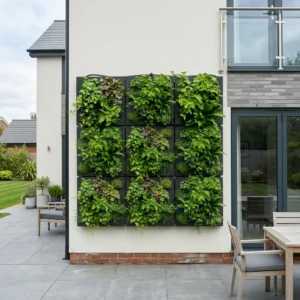
Modular green wall systems: contributing to both water management and biodiversity net gain in urban development schemes.
Smart water management systems: providing monitoring and control capability for complex SuDS schemes.
We work with civils contractors, groundworks contractors and landscapers on SuDS schemes of all scales. Our team understands the technical requirements of Schedule 3 compliance and can support specification, product selection and installation guidance for projects across England, Wales and Scotland.
If you’re working on a scheme that requires SuDS compliance and want to discuss product options or technical requirements, get in touch with our team at raingardens.co.uk.
SuDS compliance requirements are not going to become less demanding. The policy direction is clear: surface water must be managed at source, drainage must contribute to water quality, amenity and biodiversity, and developers and contractors who treat drainage as a technical afterthought will find themselves increasingly at odds with planning authorities and regulators.
The contractors who will navigate this landscape most successfully are those who understand the requirements early, design SuDS features that meet multiple objectives simultaneously, and work with suppliers who understand the technical and regulatory context.
If you’re not already treating SuDS compliance as a core competency, 2026 is the year to start.