
Most rain gardens fail for the same reason. The structure is right, the drainage works, the site is well chosen, but the planting doesn’t hold up. Plants that can’t tolerate temporary flooding sit in waterlogged soil after a downpour and slowly deteriorate. Plants that can’t handle dry periods struggle between rain events. Within a season or two, the rain garden looks sparse, weedy and neglected.
Getting the planting right is the most important decision you’ll make. The good news is that the UK has a genuinely rich palette of moisture-tolerant, wildlife-friendly plants that thrive in exactly the conditions a rain garden creates. This guide covers the best of them, organised by position, size and purpose.
Before getting into specific species, it helps to understand what you’re actually selecting for. A rain garden plant needs to do several things that most garden plants don’t.
It needs to survive temporary inundation. During and after a heavy rain event, the base of the rain garden may hold standing water for up to 48 hours. Plants in the centre of the basin need roots that won’t rot in these conditions.
It needs to tolerate drought. Between rain events, particularly in summer, a rain garden can become quite dry. The same plants that sat in water last week may be in dry, free-draining soil this week.
It needs to establish a strong root system. Deep, fibrous roots are part of what makes a rain garden work. They create channels in the soil that improve infiltration, and they take up significant volumes of water through transpiration. A plant with shallow or weak roots contributes far less to the rain garden’s function.
Ideally, it also needs to support wildlife. A rain garden is a wetland-edge habitat, and the right planting can make it one of the most ecologically productive areas in your garden.
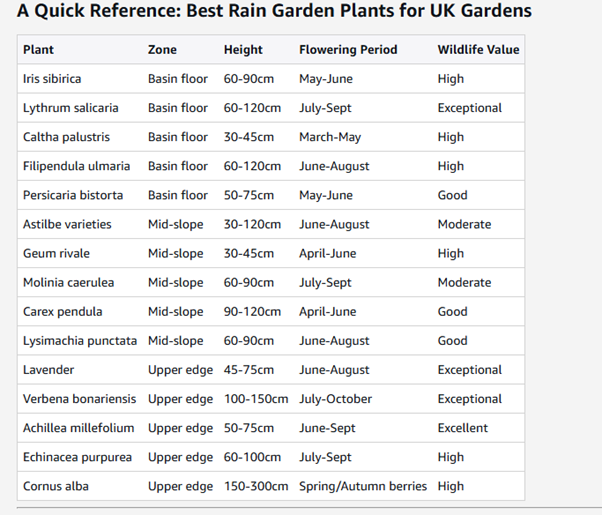
A rain garden has distinct zones, and the best results come from matching plants to the right zone rather than planting uniformly across the whole area.
Zone 1: The basin floor This is the lowest point of the rain garden, where water pools first and drains last. Plants here need the highest tolerance for standing water. They may sit in saturated soil for 24 to 48 hours after a heavy event.
Zone 2: The mid-slope The sides of the basin experience less prolonged waterlogging but are still periodically wet. This zone supports the widest range of moisture-tolerant perennials and grasses.
Zone 3: The upper edge and berm The raised edge of the rain garden rarely floods and can become quite dry. Plants here need to handle occasional moisture but should be chosen primarily for drought tolerance and their ability to visually integrate the rain garden with the surrounding garden.
One of the most reliable rain garden plants available. Siberian iris tolerates prolonged waterlogging and then handles dry conditions with equal composure. It produces elegant flowers in shades of blue, purple and white in late spring to early summer, and the upright foliage provides structure through the season. It’s fully hardy across the UK, spreads slowly to form generous clumps and requires very little attention once established.
Bees, particularly bumblebees, visit the flowers readily. It’s a plant that works hard visually and ecologically.
Height: 60 to 90cm Flowering period: May to June Wildlife value: High, particularly for bumblebees
A native UK wildflower and one of the most effective pollinator plants you can grow in a wet or moist situation. Purple loosestrife produces tall spikes of vivid magenta-pink flowers from midsummer into early autumn, and it’s genuinely exceptional for bees and butterflies. It handles waterlogged conditions well and self-seeds modestly, which helps fill gaps in the planting over time.
Worth noting: purple loosestrife is invasive in North America and some other regions, but it is native to the UK and appropriate to use in British rain gardens.
Height: 60 to 120cm Flowering period: July to September Wildlife value: Exceptional, particularly for bees and butterflies
An early-flowering native that brings bold yellow blooms to the rain garden in March and April when very little else is in flower. Marsh marigold is one of the first nectar sources available to emerging queen bumblebees in spring, which makes it ecologically valuable beyond its visual appeal. It prefers the wettest zone and can even grow at the edge of a shallow pond.
Height: 30 to 45cm Flowering period: March to May Wildlife value: High, important early season nectar source
A native UK wildflower with creamy white, fragrant flower heads that appear in midsummer. Meadowsweet thrives in wet meadows and riverbanks in the wild, which makes it perfectly adapted to the conditions a rain garden creates. It supports a wide range of insects and has a long history in traditional British landscapes. The foliage is attractive even when the plant is not in flower.
Height: 60 to 120cm Flowering period: June to August Wildlife value: High, supports beetles, flies and bees
A spreading, low-maintenance native perennial that handles moisture and temporary flooding well. It produces soft pink flower spikes in late spring and often again in late summer. Bistort spreads readily by rhizome, which makes it effective as ground cover in the wetter zones of a rain garden where you want planting to fill in quickly.
Height: 50 to 75cm Flowering period: May to June, sometimes again August to September Wildlife value: Good, particularly for bees
Astilbes are among the most versatile rain garden plants available, with varieties ranging from compact 30cm cultivars to substantial plants reaching 120cm. Their feathery plumes in shades of white, pink, red and purple provide colour through summer, and the dried seed heads persist attractively through autumn and winter. They prefer some shade but perform well in partial sun with consistent moisture.
Good varieties for UK rain gardens include Astilbe chinensis ‘Pumila’ for a compact front-of-border option, and Astilbe ‘Fanal’ for deep red flowers with a more substantial presence.
Height: 30 to 120cm depending on variety Flowering period: June to August Wildlife value: Moderate, flowers attract hoverflies and small bees
A native UK wildflower that naturally inhabits wet grasslands, stream banks and damp woodland edges. Water avens produces nodding, dusky pink and orange flowers in late spring, which are particularly attractive to bumblebees. It’s a plant that suits a more naturalistic rain garden style and connects the planting to a distinctly British ecological tradition.
Height: 30 to 45cm Flowering period: April to June Wildlife value: High, excellent for bumblebees
A native mountain and moorland plant that handles wet conditions beautifully. Globeflowers produce rounded, buttercup-yellow blooms in late spring and have a quiet elegance that suits a more refined rain garden design. They prefer cool, moist conditions and perform particularly well in northern and upland gardens.
Height: 50 to 70cm Flowering period: May to June Wildlife value: Good, supports specialist insects
One of the best ornamental grasses for a rain garden. Purple moor grass is a native species of wet moorland and acid grassland that tolerates moisture extremely well. It produces elegant, airy flower stems in midsummer that catch the light beautifully, and the foliage turns warm amber and gold in autumn. It’s fully hardy, low-maintenance and works well alongside flowering perennials throughout the rain garden.
Height: 60 to 90cm Flowering period: July to September (for decorative stems) Wildlife value: Moderate, supports grass-specialist invertebrates and provides seed for birds
A large, architectural native sedge that is highly adaptable and tolerates both wet and dry conditions once established. Its long, pendulous flower stems and bold, evergreen foliage provide year-round structure in the rain garden. It’s particularly useful for filling space quickly in a new installation while other, slower-establishing perennials develop.
Height: 90 to 120cm Flowering period: April to June (for decorative stems) Wildlife value: Good, seeds eaten by birds, supports invertebrates
Not to be confused with purple loosestrife, yellow loosestrife is a vigorous, upright perennial that produces bright yellow flowers on tall stems through midsummer. It spreads steadily by rhizome and is effective for covering ground in the mid-slope zone of a rain garden. It handles wet conditions well and is visited by a range of bee species.
Height: 60 to 90cm Flowering period: June to August Wildlife value: Good, particularly for mining bees
The upper edge of a rain garden can become quite dry between events, and lavender is perfectly suited to these conditions. It provides nectar from midsummer into early autumn and integrates the rain garden visually with a more conventional garden planting scheme. It also provides a useful contrast in texture and colour against the larger-leaved moisture plants lower in the basin.
Height: 45 to 75cm Flowering period: June to August Wildlife value: Exceptional, one of the best garden plants for bees
A tall, airy perennial that produces small clusters of purple flowers on wiry stems from midsummer into autumn. It’s one of the most effective plants available for attracting butterflies, particularly red admirals and painted ladies, and it works beautifully at the upper edge of a rain garden where its transparent structure doesn’t obscure the planting behind it. It self-seeds freely, which means it moves around the garden and fills gaps in a natural, unforced way.
Height: 100 to 150cm Flowering period: July to October Wildlife value: Exceptional, particularly for butterflies
A native UK wildflower that thrives in free-draining conditions and handles dry periods well. Yarrow produces flat-topped flower heads in white, yellow, pink or red depending on the variety, and it’s visited by a wide range of insects including beetles, flies, bees and butterflies. The native white form is particularly good for wildlife. It spreads by rhizome and self-seeds modestly, which helps it establish across the upper edge of a rain garden quickly.
Height: 50 to 75cm Flowering period: June to September Wildlife value: Excellent, supports a very wide range of insects
A robust, drought-tolerant perennial that suits the drier upper edge of a rain garden well. Coneflowers produce large, daisy-like flowers with prominent central cones through summer and early autumn, and both the flowers and seed heads are valuable to wildlife. Bees visit the flowers heavily, and goldfinches and other seed-eating birds work through the seed heads in autumn and winter.
Height: 60 to 100cm Flowering period: July to September Wildlife value: High, good for bees and seed-eating birds
If there’s space for a shrub at the upper edge of your rain garden, dogwood is an excellent choice. It tolerates moist conditions well, produces berries that birds eat readily in autumn, and its bare winter stems in shades of red, orange or yellow provide genuine visual interest through the coldest months. Cut back hard every two to three years to maintain the most vivid stem colour on young growth.
Height: 1.5 to 3m if unmanaged, easily kept smaller with regular pruning Wildlife value: High, berries for birds, flowers for insects
A rain garden planted entirely with UK native species will deliver the highest ecological value. Native plants have evolved alongside native insects, and many specialist species are dependent on particular native plants that non-natives simply cannot replace.
That said, a mix of native and wildlife-friendly non-native plants is a practical and effective approach for most domestic rain gardens. Many non-native species, like Astilbe, Echinacea and Verbena bonariensis, provide significant nectar and pollen that native insects use readily, even if they don’t support specialist species in the same way native plants do.
The key is to avoid plants bred primarily for ornamental impact at the expense of wildlife value. Double-flowered varieties, in particular, often make nectar and pollen inaccessible to insects. Where possible, choose single-flowered forms.
Plant densely from the start. A rain garden with gaps in the planting is a rain garden filling up with weeds. Aim for full coverage from planting day and use a biodegradable mulch to suppress weeds while plants establish.
Use a mix of plant sizes and forms. Tall, upright plants like purple loosestrife and Verbena bonariensis, mid-height spreading plants like bistort and yellow loosestrife, and lower ground-covering species like marsh marigold create a layered planting that looks intentional and supports more species.
Leave seed heads standing through winter. The seed heads of Echinacea, Molinia, Astilbe and many other rain garden plants provide food for birds and overwintering habitat for insects. Cut back in late February or early March rather than in autumn.
Water in the first season. Rain garden plants are resilient once established, but they need support during their first summer while root systems develop. Water during dry spells in year one, and they’ll largely look after themselves from year two onward.
Mulch annually. A layer of bark mulch or gravel over the growing medium suppresses weeds, retains moisture during dry periods and gradually improves soil structure as it breaks down.
The plants in a rain garden are not just decorative. They are a functional part of the water management system. Their roots create the infiltration pathways that allow water to move through the growing medium. Their transpiration removes significant volumes of water from the system between events. Their canopy cover reduces evaporation from the soil surface in summer.
A rain garden planted with the right species, in the right zones, at the right density performs measurably better than one that is either bare or poorly planted. It manages more water, manages it more reliably and does so year after year with minimal intervention.
Browse rain garden kits, growing media and biodiversity products at raingardens.co.uk